


Geotechnical Advantages of Basement Construction
Basement structures play a critical role in modern construction, offering a range of functional,
structural, and economic advantages such as basements optimize land use by providing
additional floor space below ground, which is particularly valuable in urban areas where surface
space is limited or expensive. Structurally, basements contribute to the overall stability of a
building by deepening the foundation and lowering the center of gravity, improving resistance to
lateral forces such as wind and seismic activity.
Improved Load-Bearing and Reduced Settlement
From a geotechnical engineering perspective, basement structures offer several important
advantages such as improved load-bearing capacity, lateral stability. By extending the structure
deeper into the ground, basements allow foundations to reach more competent soil or rock strata,
which can safely support structural loads and minimize settlement. This is especially critical in
areas with soft or compressible surface soils, where shallow foundations may not be suitable.
Basements also enhance the lateral stability of a structure. The basement walls act as retaining
elements, resisting lateral earth pressures and contributing to the overall stiffness of the
foundation system. This is particularly beneficial in sloped or uneven terrain, or in seismic regions
where lateral forces are significant. Additionally, in groundwater-prone areas, basement
construction can be designed with waterproofing systems and dewatering methods to manage
hydrostatic pressure and prevent water ingression.
Why Shoring Systems Are Essential for Deep Excavations
Preventing Soil Collapse and Ground Movement
Shoring support is crucial in deep excavation projects to ensure stability, safety, and structural
integrity. As excavation depth increases, the surrounding soil becomes less stable due to higher
lateral earth pressure, making it more prone to collapse. Shoring systems, such as soil nailing,
micro-piles, sheet piles, soldier piles with lagging, secant piles, touch piles or diaphragm walls,
are installed to support the excavation walls and prevent soil cave-ins. This is particularly
important in urban environments where excavations often occur near existing buildings, roads,
and underground utilities; shoring helps prevent ground movement and vertical settlements in the
adjacent site. Additionally, shoring enhances worker safety by providing a secure environment
and reducing the risk of accidents from soil collapse. It also helps control groundwater intrusion
and soil erosion, both of which can weaken the excavation and compromise its integrity.
Micropiles with Grouted Anchors as an Efficient Shoring Solution
How Micropiles Perform Under Lateral Earth Pressure
Micropiles with grouted anchors are considered an efficient shoring support system because
they combine high load-bearing capacity with flexibility and adaptability to challenging site
conditions. Micropiles are small-diameter, drilled and grouted piles that can be installed in
restricted spaces and through difficult soils or rock, making them ideal for urban or confined
excavation sites. When combined with grouted anchors—tendons or cables anchored into stable
soil or rock—the system provides strong lateral support to retain excavation walls by actively
resisting earth pressures.
Role of Grouted Anchors in Deep Excavation Support
The grouted anchors transfer tensile forces deep into competent ground layers, enhancing the
overall stability of the shoring system; the micropiles provide vertical and lateral load resistance
with minimal vibration and disturbance to surrounding structures; and the system can be
customized in terms of length, inclination of anchors and spacing to suit specific geotechnical
conditions. Overall, their high strength-to-size ratio, versatility, and minimal impact on existing
infrastructure make micropiles with grouted anchors an efficient and reliable choice for shoring
support in deep excavations. Micropiles with grouted anchors are considered temporary support
systems because they are primarily intended to maintain excavation stability during construction,
use materials suited for short-term service, and are often not relied upon for long-term structural
integrity. However, they can be designed as permanent systems if required, by enhancing
corrosion protection and meeting long-term design criteria.
Design Considerations for Micropile and Anchor Shoring Systems
Site Investigation and Subsurface Analysis
Designing a Micropile with grouted anchor shoring support system involves a comprehensive
process that integrates geotechnical, structural, and construction considerations.
Common Failures in Micropile–Anchor Shoring Systems
Case Study 1 – 19m Deep Excavation in Bangalore
Two-Tier Micropile Wall System
A deep excavation of 19 m was planned at a project site in Bangalore for the construction of a 3
Basements + Ground + 10-Storey (3B+G+10) office building. Based on the subsurface
investigation, the soil profile was identified as predominantly dense to very dense silty sand.
Given the substantial excavation depth, a two-tier Micropile wall system of varying level of
Micropile depths.
GEO5 and Plaxis 2D Validation
Geotechnical analysis was initially performed using GEO5 software. However, due to the limitation
in GEO5, which does not support simultaneous modeling of micropiles at two different levels, the
two Micropile rows were analyzed independently. In this approach, the surcharge load from
the upper Micropile level was incorporated into the analysis of the lower level Micropile to
simulate the interaction effects realistically.
To validate the design, a Finite Element Analysis (FEM) was also conducted using Plaxis 2D.
The results from both GEO5 and Plaxis showed good agreement, confirming the reliability of
the adopted approach and economical ensuring adequate safety without compromising
performance.
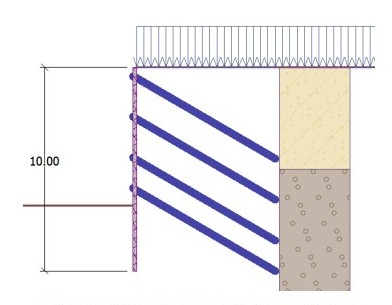
Figure 1. GEO-5 Model- Higher level Micropile
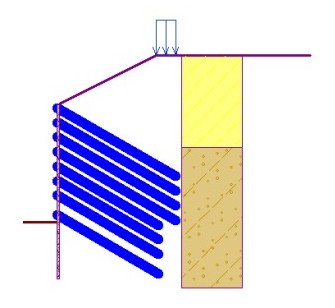
Figure 2. GEO-5 Model- Lower level Micropile
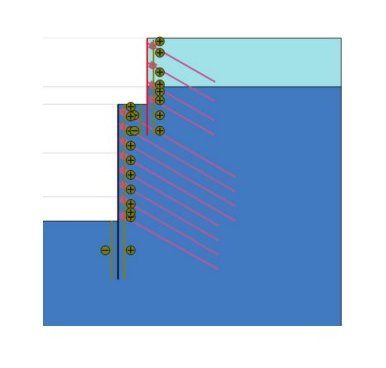
Figure 3. Plaxis 2D model
Case Study 2 – Excavation Collapse Due to Missing Shoring
Urban Constraints and Groundwater Risks
The critical importance of a shoring support system for deep excavations is exemplified through
a case study from a completed project. The project involved a planned 12 m deep excavation,
located in a sensitive urban environment, surrounded by high-rise structures and in close
proximity to a natural lake. A temporary shoring system comprising micropiles with grouted
anchors was designed and implemented to ensure safe excavation in most areas.
However, in one specific stretch—characterized by a large setback and absence of adjacent
structures—the client opted for vertical excavation without any support system, under the
assumption that the applied surcharge loads would be minimal and that groundwater ingress
would not occur. Unexpectedly, following heavy rainfall, water infiltrated the unsupported
excavation zone through an adjacent property's rainwater harvesting pit, leading to rapid water
ingression into the excavated area. This sudden increase in pore water pressure critically reduced
the effective stress within the soil mass, causing a localized failure and collapse of the
unsupported excavation wall. Figure -4 illustrates the collapse observed in the section where no
shoring support system was provided, emphasizing the risks associated with unsupported deep
excavations, particularly in variable climatic and urban conditions.
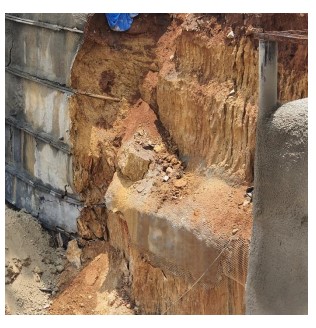
Figure 4. Collapse of soil where no temporary supports provided