


In recent years, the construction industry of India has witnessed significant growth with the inclusion of several mega projects like metro railways, Bharatmala Pariyojna, Sea links, etc., and it is expected to grow exponentially. This has led to an increase in demand for foundation testing, particularly pile foundation, to ensure the safety and reliability of any project. Traditionally, static pile testing has been the go-to method for testing pile capacity, but recently, there has been an increasing interest in bidirectional load testing as an alternative method with significant advantages.
Advantages of Bidirectional Load Testing Over Static Pile Tests
Static pile testing involves measuring the load capacity of a pile by applying a static load to the pile and monitoring its behavior. This method is reliable but can be time-consuming and expensive. Bidirectional load testing, on the other hand, is a relatively new method that involves applying both upward and downward loads to a pile using a reaction frame, which can provide accurate results within a shorter time frame.
One of the significant advantages of bidirectional load testing is its ability to measure the load-deflection response of a pile. This allows engineers to determine the ultimate load capacity of the pile, as well as the load-displacement behavior of the pile during the loading cycle.
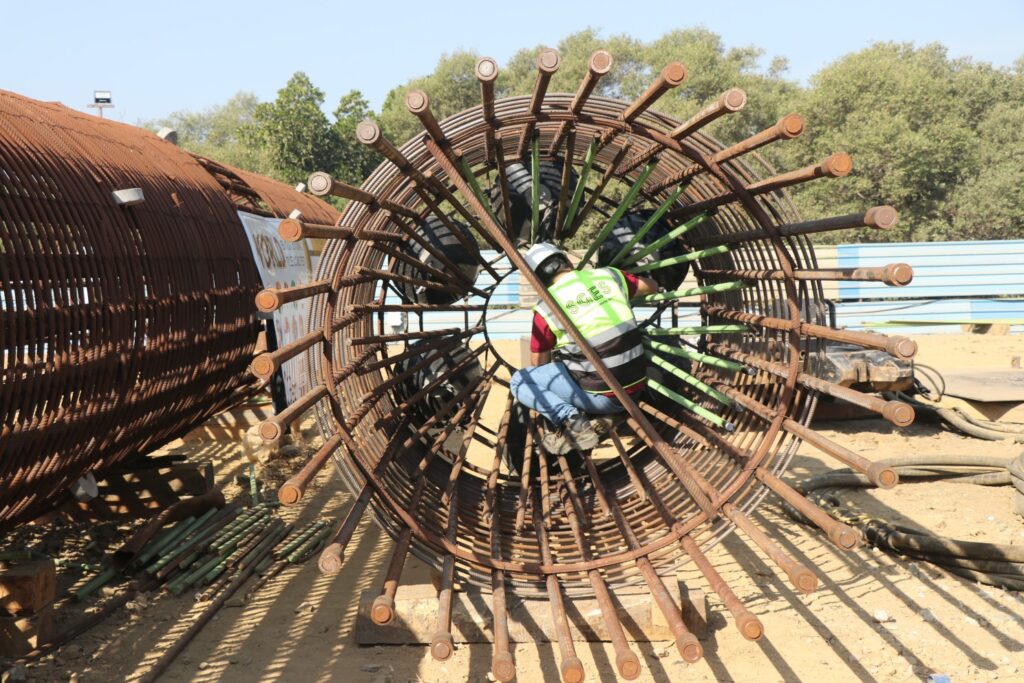
The test results can separate out soil/rock resistance and movement data for shaft and toe individually and hence can give information on the magnitude of mobilized shaft and toe resistances. Additionally, if strain gauges are used at different depths during the foundation casting, data from these strain gauges during the testing can give valuable information about soil/ rock resistance distribution along the foundation length.
The cost of load testing is a significant consideration for construction projects in India. Bidirectional load testing is generally less expensive than traditional static pile testing, mainly because it requires fewer resources and can be performed in a shorter period. The time and cost savings provided by bidirectional load testing can be particularly beneficial for projects with tight schedules or budget constraints.

Furthermore, bidirectional load testing can be performed using a smaller reaction frame compared to static pile testing. This means that it can be performed in locations with limited space or challenging access. This is particularly important in densely populated urban areas where construction sites are often located in tight spaces.
Despite its advantages, bidirectional load testing is not without its limitations. One of the significant concerns is the lack of standardization of testing procedures. Additionally, bidirectional load testing is relatively new in India, and there is a lack of trained personnel who can perform the tests accurately and safely.
The bidirectional load test is an alternative to the static pile test that offers several advantages, including faster testing times, lower costs, and more accurate results.
Although the use of this test is growing in India, the static pile test remains the most used method of foundation testing. The future of the bidirectional load test in India will depend on several factors, including the availability of specialized equipment, the cost of the test, and the availability of skilled personnel to perform the test.
Regardless, the bidirectional load test is a promising alternative that offers significant advantages and should be considered for use in construction projects.
SGES provides advanced pile testing solutions including bidirectional load tests across India, UAE, KSA, and Indonesia to support faster, accurate, and cost-effective foundation assessment.
Contact Us: +91 91640 00080