

Conducting in-situ testing to evaluate rock / soil permeability is essential for obtaining accurate, site-specific data about fluid flow properties within the rock / soil mass under natural conditions. While laboratory tests provide valuable insights, they often fail to capture the complexities of the field environment, including stress states, fractures, and heterogeneity within the rock mass. Techniques like packer tests are commonly employed based on the geological setting and depth. The packer test, in particular, is a widely used method for isolating sections of rock to measure permeability in a controlled manner, ensuring that the permeability of specific rock layers is accurately assessed. This is especially important when dealing with fractured or heterogeneous rock masses, where fluid flow can vary significantly. In-situ tests also allow for assessing large-scale permeability, which is often challenging especially in highly weathered rocks, stiff soil deposits, or refusal layers.
Importance of In-Situ Permeability Testing in Rock and Soil
In-situ permeability testing plays a vital role in tunnel construction and investigation. For tunnels, understanding the permeability of the surrounding rock is crucial to assess groundwater flow, potential seepage, and pressure on the tunnel structure. It helps engineers design effective drainage systems, prevent water ingress, and ensure the stability of the tunnel. Accurate permeability data also supports the prediction of water-related risks, such as flooding or erosion, during construction and throughout the tunnel's operational lifespan.
In-situ permeability testing is an essential part of our Soil & Rock Testing services, enabling accurate assessment of rock mass behavior under natural conditions.
In-situ permeability testing is an essential part of our Soil & Rock Testing services, enabling accurate assessment of rock mass behavior under natural conditions.
Understanding Natural Stress, Fractures & Heterogeneity
Understanding in-situ permeability is vital for designing and optimizing groundwater extraction, petroleum recovery, and geothermal energy systems. It is also critical for evaluating the integrity of engineered structures like dams, tunnels, and underground waste disposal sites. Additionally, packers can be employed in groutability testing by injecting grout into rock formations to evaluate their ability to seal fractures or voids for effective grouting.
How the Packer Permeability Test Works
Working Principle of Packer Testing
Types Lugeon test for rock and constant & variable head test for soil
Description: Uses inflatable packers to isolate a section of a borehole. Water is injected, and the flow rate is measured under different pressure.
Principle on Packer Permeability Test
The packer permeability test isolates a section of a borehole using inflatable packers to measure the permeability of the rock. Fluid is injected under controlled pressure into the isolated zone of the drill hole, and the flow rate is recorded. The test assesses the rock's ability to transmit fluid, with permeability determined by the relationship between the applied pressure and flow rate.
Results are expressed in Lugeon units, indicating the flow rate per meter of test section at a specified pressure. The test is based on the principles of fluid dynamics and laminar flow, providing essential data for hydrogeological and geotechnical evaluations.
Packer tests are categorized based on the configuration of the packers, the purpose of the test, and the pressure conditions applied. At SGES, we perform various types of packer tests to suit specific project needs. Below are the two main types of packer tests we conduct:
The packer permeability test isolates a section of a borehole using inflatable packers to measure the permeability of the rock. Fluid is injected under controlled pressure into the isolated zone of the drill hole, and the flow rate is recorded. The test assesses the rock's ability to transmit fluid, with permeability determined by the relationship between the applied pressure and flow rate.
Results are expressed in Lugeon units, indicating the flow rate per meter of test section at a specified pressure. The test is based on the principles of fluid dynamics and laminar flow, providing essential data for hydrogeological and geotechnical evaluations.
Packer tests are categorized based on the configuration of the packers, the purpose of the test, and the pressure conditions applied. At SGES, we perform various types of packer tests to suit specific project needs. Below are the two main types of packer tests we conduct:
Types of Packer Tests Performed at SGES
Single-Packer Test – Application & Suitability
Description: A single packer is used to seal the borehole above the test section, leaving the lower portion of the borehole open for testing.
Application: Suitable for shallow tests and when the full length of the borehole cannot stand uncased/ungrouted in soft rocks, such as sand rocks, clay shale or highly fractured and sheared nature of the rocks.
Description: A single packer is used to seal the borehole above the test section, leaving the lower portion of the borehole open for testing.
Application: Suitable for shallow tests and when the full length of the borehole cannot stand uncased/ungrouted in soft rocks, such as sand rocks, clay shale or highly fractured and sheared nature of the rocks.
Double-Packer Test – Application & Advantages
Description: Two inflatable packers are used to isolate a specific interval of the borehole, creating a sealed test section between the packers.
Application: Suitable for shallow tests and when the full length of the borehole cannot stand uncased/ungrouted in soft rocks, such as sand rocks, clay shale or highly fractured and sheared nature of the rocks.
Description: Two inflatable packers are used to isolate a specific interval of the borehole, creating a sealed test section between the packers.
Application: Suitable for shallow tests and when the full length of the borehole cannot stand uncased/ungrouted in soft rocks, such as sand rocks, clay shale or highly fractured and sheared nature of the rocks.
Test sections:
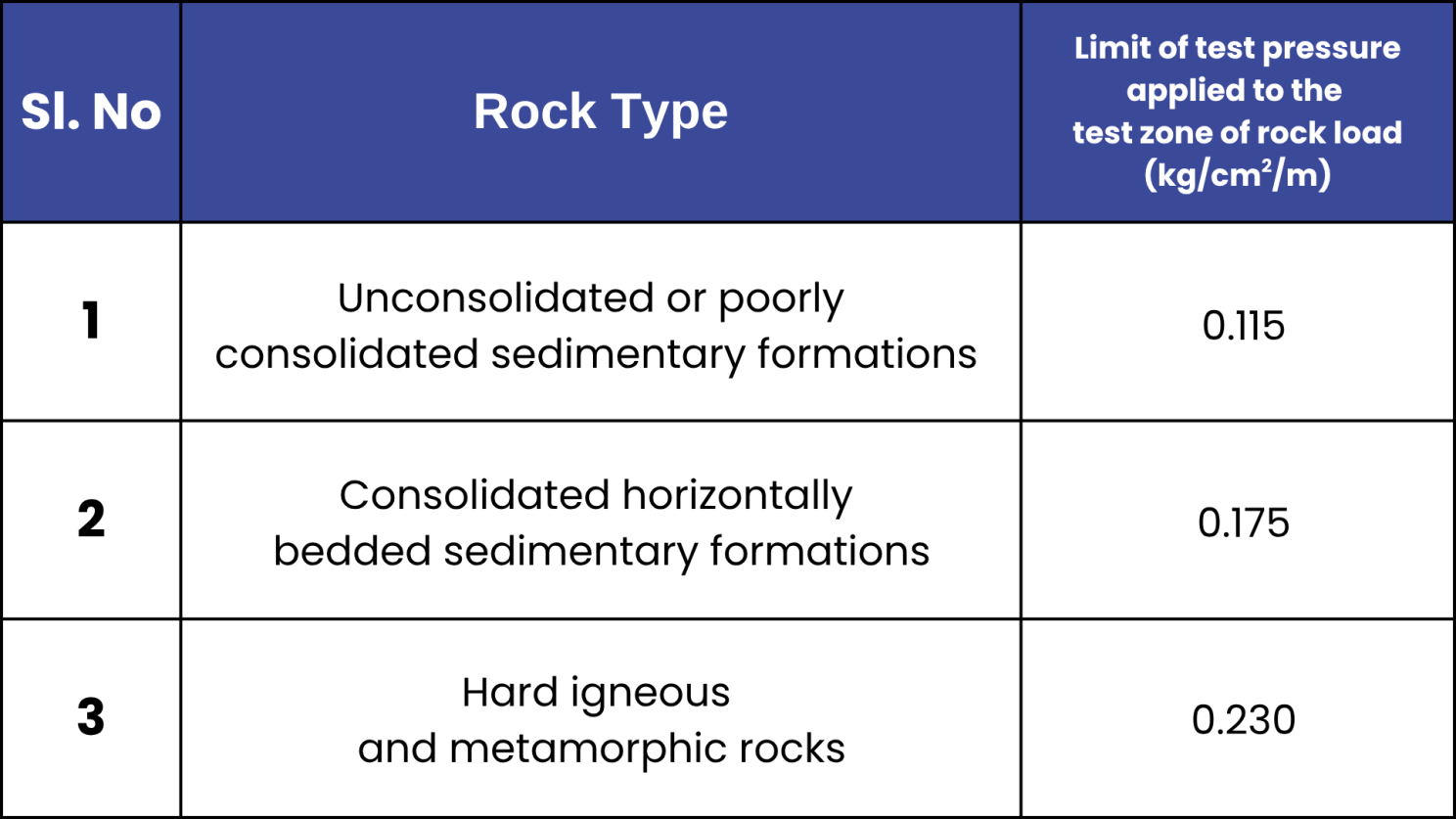
The tests are recommended to be performed in 1.5 m to 3 m test sections depending upon the geological conditions. Short test sections of 1.5 m would be preferred in thin bedded and heterogeneous strata. Under normal circumstances test sections longer than 3 m are not recommended.
Pressure Stages, Stabilization & Measurement
The pressure should be maintained until the readings of water intake at intervals of 5 min show a nearly constant reading of water intake for a particular pressure at the collar. It is very important to note the level of ground water table in the borehole.
The pressure should be maintained until the readings of water intake at intervals of 5 min show a nearly constant reading of water intake for a particular pressure at the collar. It is very important to note the level of ground water table in the borehole.
Water loss measurement:
The water loss may also be expressed in Lugeons. A Lugeon is defined as the water loss of 1litre/min/m under a pressure of 10 atmospheres maintained for 10 min in a drill hole of 46 mm to 76 mm diameter.
Why Choose SGES for Packer Testing?
Testing As Per IS 5529 (Part 2):2006
At SGES, we ensure that each packer test is performed according to IS 5529: Part 2 (2006), providing you with reliable and accurate data. Our team uses state-of-the-art equipment to conduct these tests efficiently, ensuring that the results are both comprehensive and precise. Whether it's for assessing groundwater flow, designing tunnels, or evaluating rock stability, SGES delivers high-quality results that guide your project's success
State-of-the-Art Equipment & Trained Team
Experience the SGES Difference:
– Partner with us for advanced in-situ permeability testing and make informed decisions based on reliable, real-world data.
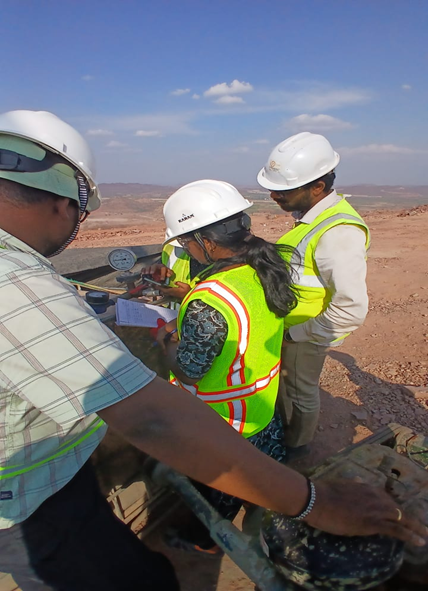
Conducting In-situ Permeability test using double packer equipment at a Dam site in Andhra Pradesh

Conducting In-situ Permeability test using double packer equipment in Chennai, Tamil Nadu
We perform detailed subsurface investigations including packer tests, Lugeon tests, permeability evaluation, groutability testing, and rock characterization as part of our Soil & Rock Testing service.
packer permeability test, lugeon test in rock, in-situ permeability testing, single packer test, double packer test, rock permeability evaluation, groundwater flow assessment, tunnel permeability testing, groutability testing, rock mass permeability, hydrogeological investigations, fracture permeability analysis, borehole permeability test, permeability under pressure, packer test procedure, lugeon value interpretation, permeability test for dams, permeability in weathered rock, pressure water test, site-specific permeability evaluation